
Article

Himanshi Chopra
21/08/2026
Choosing where to study fashion design is one of the biggest decisions an aspiring designer makes, and Delhi-NCR is one of the best places in India to do it. Home to NIFT, UDIT (formerly IIAD), Pearl Academy, JD Institute and Amity, the region pairs design education with direct access to India’s fashion industry, from the textile markets of Chandni Chowk to major fashion weeks.
Table of content:
- The 5 colleges at a glance (2026-27)
- How we chose these five, and how we sourced the numbers
- National Institute of Fashion Technology (NIFT)
- UDIT (formerly Indian Institute of Art and Design, IIAD)
- JD Institute of Fashion Technology
- Pearl Academy
- Amity School of Fashion Technology
- Comparison of the five colleges
- Eligibility
- Scholarships and financial aid
- How to choose the right college for you
- Why choose Delhi-NCR for fashion design education?
- FAQs
- Explore more about fashion design
This guide compares the top five fashion design colleges in Delhi-NCR on what actually decides your choice: programmes, fees, eligibility, entrance exams, scholarships, placements and salaries. If you want the national picture first, see our guide to the 10 best fashion design colleges in India.
The 5 colleges at a glance (2026-27)
College (campus) |
Entrance route |
First-year fee |
Reported average package |
JD Institute, South Extension |
GAT |
Rs 1.75–2.17 lakh (unconfirmed) |
Rs 4–7 LPA |
Amity, Sector 125 Noida |
Creative test + interview |
Rs 2.28 lakh |
Rs 4–9 LPA |
NIFT, Hauz Khas |
NIFTEE (CAT + GAT) + Situation Test |
Approx. Rs 3.0–3.5 lakh |
Rs 8–12 LPA |
UDIT, Sector 68 Gurugram |
U-DAT + studio simulation |
Rs 5.95 lakh |
Rs 7.5–12 LPA |
Pearl Academy, Naraina / New Friends Colony |
Written test + interview |
Rs 6.92–7.88 lakh |
Rs 5–9 LPA |
Fees exclude hostel, materials and living costs, and rise each year at most private institutes. Salary figures are reported by the institutions themselves and are not independently audited. Treat them as indicative, and read the section on how to interrogate them.
Two of these sit just outside Delhi proper: UDIT is in Gurugram and Amity is in Noida, both within Delhi-NCR and within easy reach of Delhi’s fashion ecosystem.
How we chose these five, and how we sourced the numbers.
We selected the five institutions in Delhi-NCR that offer a full-time undergraduate fashion design degree, have been running it for at least five years, and publish enough admissions information to compare. Every fee figure below is for B.Des Fashion Design, first year, 2026-27, taken from each institute’s own published fee schedule where one exists. Where an institute does not publish its fees publicly, we say so instead of repeating a third-party estimate.
1. National Institute of Fashion Technology (NIFT)
NIFT is India’s best-known fashion school. Since 1986 it has launched some of India’s most celebrated designers, and its curriculum spans garment construction, textile science, fashion communication and management, with heavy industry exposure.
Established: 1986
Location: Hauz Khas, South Delhi
Recognition: Ministry of Textiles, Government of India.
Notable alumni: Sabyasachi Mukherjee, Rohit Bal, Prabal Gurung.
Best for: exam-strong students who want the top brand and the best value for money.
Watch out for: the under-24 age cap, which is a hard disqualifier no other college here applies; and the competition. NIFTEE is the most demanding entrance route on this list, with a Situation Test that cannot be crammed.
Key factors |
Details |
Campus |
3.5-acre campus, Hauz Khas, South Delhi |
Recognition |
Ministry of Textiles |
First-year fee |
Approx. Rs 3.0–3.5 lakh; first semester higher (approx. Rs 1.8 lakh) due to one-time charges |
Indicative 4-year cost |
Rs 13.49–14.09 lakh |
Entrance |
NIFTEE (CAT + GAT), Situation Test, interview |
Scholarships |
SARTHAK (income-based tuition waiver), UDAAN (overseas study) |
Admission: applications open around December; the entrance exam (NIFTEE, comprising the Creative Ability Test and General Ability Test) is held around February, followed by a Situation Test, interview and final merit list.
Placements: recruiters include Louis Vuitton, Armani, H&M, Zara, Sabyasachi and Raw Mango.
2. UDIT (formerly Indian Institute of Art and Design, IIAD)
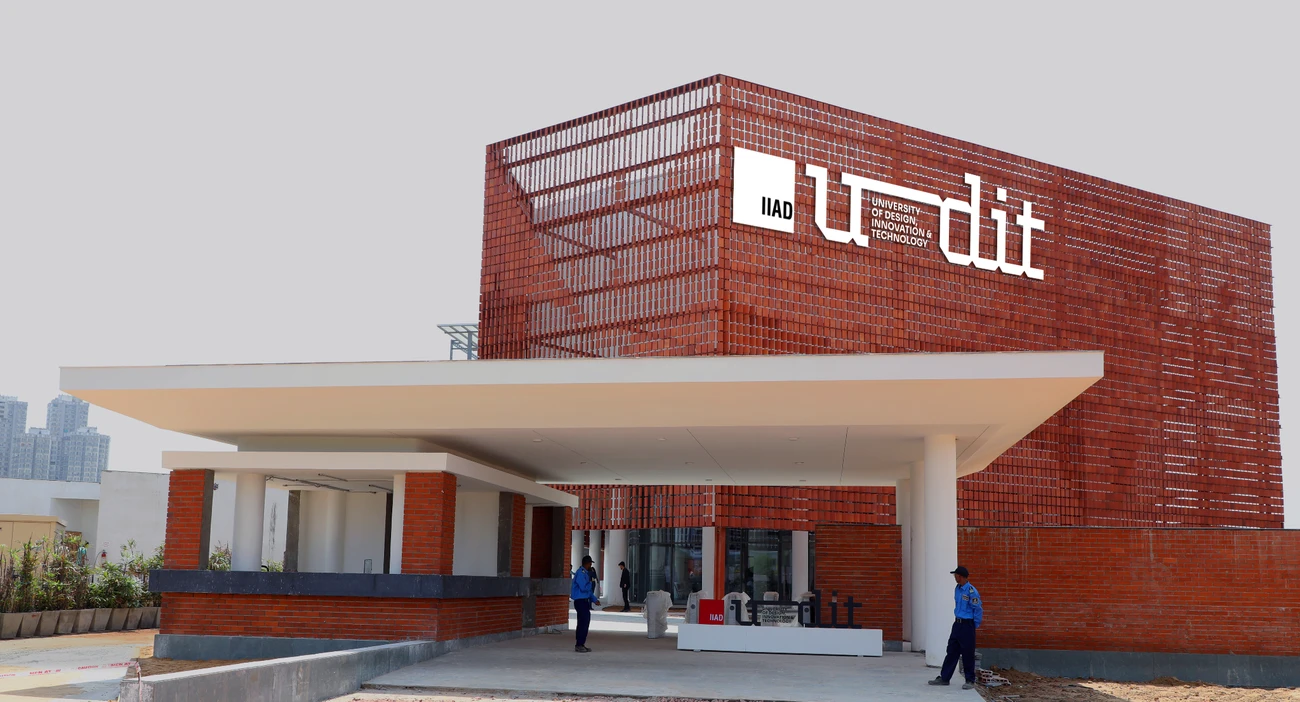
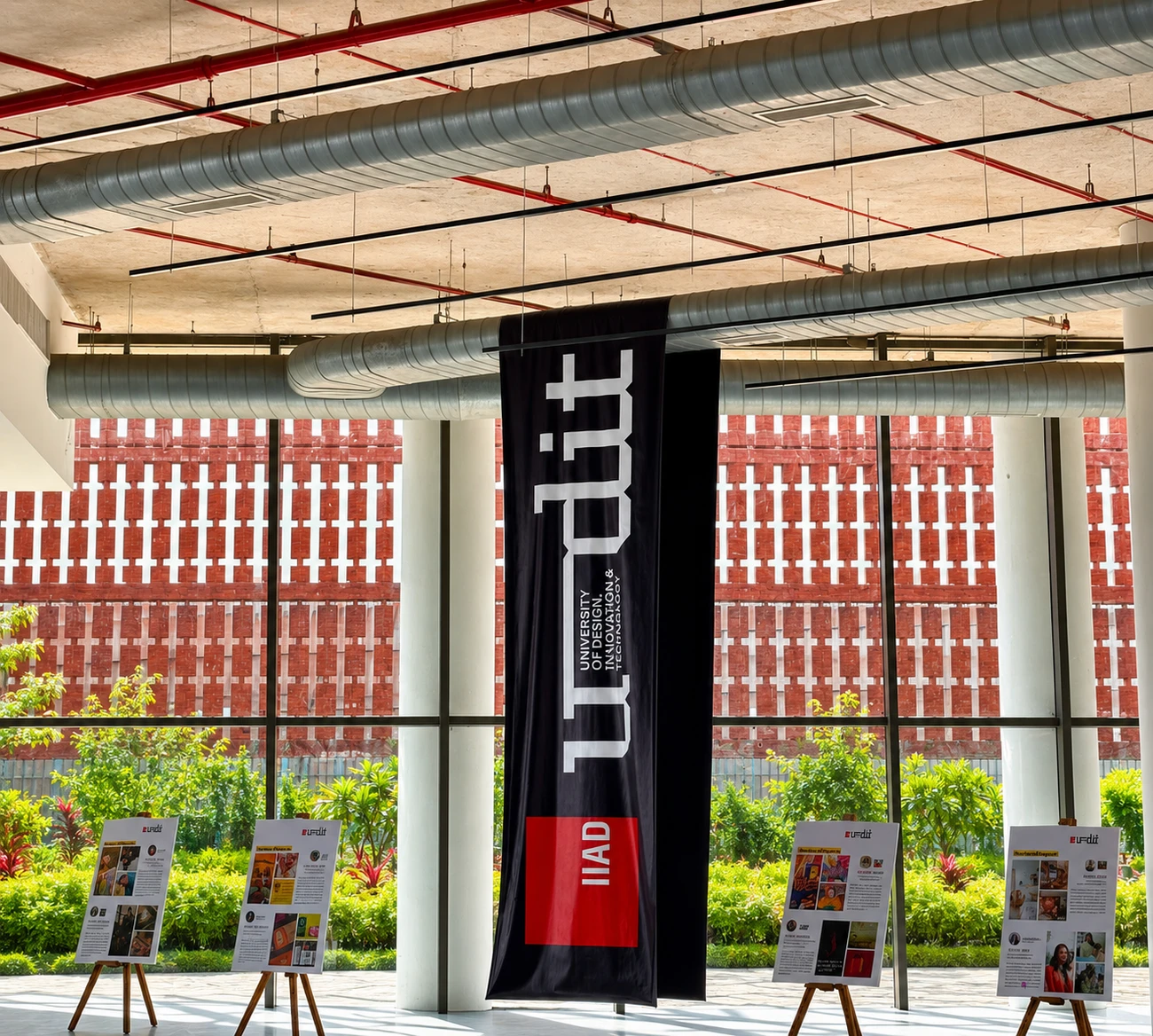
UDIT is a practice-led design school where students work on live briefs from fashion houses such as FabIndia, H&M and Uniqlo, learning concept development, budgeting and client presentation. Its B.Des (Hons) Fashion Design programme is built on a dual-internship structure: an 8-week craft-to-market placement and a 16-week industry placement with companies such as Levi’s, Pero and Tarun Tahiliani, covering concept, sampling and merchandising.
Established: 2015 as IIAD; became a State Private University under the Haryana Private Universities (Amendment) Act, 2025.
Location: Sector 68, Gurugram.
Alliances: FDCI, IFFTI, Cumulus.
Notable alumni: Anas Sheikh (Class of 2020), whose collection 23N.69E featured in Vogue India, Jan-Feb 2024.
Best for: portfolio-led students who want small-cohort studio depth and long industry internships.
Watch out for: the second-highest fee on this list; university status is new.
Key factors |
Details |
Campus |
Sector 68, Gurugram (Delhi-NCR) |
Recognition |
State Private University, Haryana |
First-year fee |
Rs 5.95 lakh (Rs 2,97,500 × 2 semesters) |
One-time charges |
Rs 70,000 (admission Rs 50,000 + security deposit Rs 20,000) |
Other annual charges |
Rs 35,000 (software Rs 10,000 + meal plan Rs 25,000) |
Entrance |
U-DAT and studio simulation round |
Scholarships |
Merit-cum-means, awarded case by case |
Admission: submit the application form, appear for the UDIT design aptitude test (U-DAT), then a studio simulation round, followed by the result.
Placements: graduates have gone on to brands including 11:11, Antaragni, Shweta Kapur’s 431-88, Hemant and Nandita, and Urvashi Kaur.
Learn more about the B.Des Fashion Design course at UDIT.
Disclosure: UDIT is our own school. We have listed it here openly, and we have included its drawbacks alongside everyone else’s. Please weigh it on exactly the same factors as every other institute.
3. JD Institute of Fashion Technology
Since 1988, JD Institute has built a reputation for experimental design thinking and practical, industry-focused training, with a wide range of degree and diploma routes across more than 35 learning centres in India.
Established: 1988.
Location: South Extension, New Delhi.
Notable alumni: Dhruv Vaish.
Best for: students who want a lower-cost, practical entry into fashion design, or a shorter diploma route.
Watch out for: fee transparency. JD does not publish a fee schedule publicly and figures vary by centre, so get the South Extension numbers in writing. Because it operates as a multi-centre network, facilities and teaching quality can differ between locations, and degree-awarding arrangements differ from diplomas. Visit the specific centre you would attend.
Key factors |
Details |
Campus |
South Extension, New Delhi |
First-year fee |
Rs 1.75–2.17 lakh |
Entrance |
GAT (General Aptitude Test) |
Routes offered |
Bachelor’s (3 yr), B.Des (4 yr), PG (2 yr), advanced diploma (2 yr) |
Scholarships |
Not published; confirm with the centre |
Admission: register online, pay the application fee, receive the GAT admit card and take the GAT.
Placements: recruiters of JD alumni include H&M, Zara, Pantaloons, Rocky S, Urvashi Kaur and Shane Peacock.
4. Pearl Academy
With a legacy of three decades, Pearl Academy is known for industry-focused, technology-forward fashion education and strong brand partnerships, with two Delhi campuses.
Established: 1993.
Location: Naraina (West Delhi) and New Friends Colony (South Delhi).
Accreditation: NAAC A++ grade.
Partnerships: Tommy Hilfiger, Marks & Spencer.
Best for: students who want tech-forward, industry-connected private study with global exposure, and who can compete for a scholarship.
Watch out for: this is the most expensive option on the list at sticker price, materially more than UDIT once you compare like for like. Pearl states on its own fee page that fees rise annually. Most of its scholarships apply to the first year only, so model the full four years at full price before you assume a discount carries through.
Key factors |
Details |
Campuses |
Naraina (West Delhi); New Friends Colony (South Delhi) |
Recognition |
NAAC A++ |
First-year fee |
Rs 6.92 lakh (Naraina) / Rs 7.88 lakh (South Delhi) |
One-time charges |
Rs 85,000 |
Entrance |
Written test (GPT + DAT), Comprehensive Aptitude Interview |
Scholarships |
Five schemes; all applicants auto-assessed |
Admission: online application in December, then the written test, portfolio assessment and interview.
Placements: Pearl reports average packages of Rs 5–9 LPA, with international study tours available.
5. Amity School of Fashion Technology
Part of the Amity University ecosystem, the School of Fashion Technology stands out for a research-driven approach and a strong emphasis on sustainable design. On a like-for-like annual basis, it is also one of the more affordable options here.
Established: 2002.
Location: Sector 125, Noida.
Recognition: UGC-recognised.
Industry partners: FDCI, Apparel Export Promotion Council.
Best for: students who want a research-driven, sustainability-focused course at a lower annual fee, inside a large multidisciplinary university.
Watch out for: fashion is one school inside a very large university, so studio cohorts and individual attention differ from a specialist school. Amity also operates sponsored and non-sponsored fee tiers, and the sponsored rate is roughly 50% higher, so confirm which one you are being offered. And check which specialisation you are applying to: Fashion Design, Fashion Communication, Fashion Technology and the 3-Continent variant all price differently.
Key factors |
Details |
Campus |
Sector 125, Noida (Delhi-NCR) |
Recognition |
UGC-recognised |
First-year fee |
Rs 2.28 lakh non-sponsored (Rs 1.14 lakh × 2 semesters); Rs 3.42 lakh sponsored |
Indicative 4-year cost |
Rs 9.1–11.1 lakh |
Entrance |
Creative test, personal interview |
Scholarships |
On-admission merit, entrance-based, sports, category waivers |
Admission: a creative test followed by a personal interview.
Placements: Amity reports average packages of Rs 4–9 LPA, with recruiters including Van Heusen, Allen Solly and Tommy Hilfiger, plus international placement programmes.
Comparison of the five colleges
Factor |
NIFT |
UDIT |
Pearl |
JD |
Amity |
First-year fee |
~Rs 3.0–3.5 L |
Rs 5.95 L |
Rs 6.92–7.88 L |
Rs 1.75–2.17 L (unconfirmed) |
Rs 2.28 L |
Entrance route |
NIFTEE + Situation Test |
U-DAT |
Written test + interview |
GAT |
Creative test + interview |
Age limit |
Under 24 |
None stated |
None stated |
None stated |
None stated |
Minimum Class 12 marks |
None stated |
50% |
None stated |
Approx. 40% |
50% |
Published scholarship slabs |
Yes (income-based) |
No |
Yes (five schemes) |
Not published |
Yes (marks-based) |
Reported average package |
Rs 8–12 LPA |
Rs 7.5–12 LPA |
Rs 5–9 LPA |
Rs 4–7 LPA |
Rs 4–9 LPA |
Eligibility
Before you shortlist on fees or placements, check that you qualify. Eligibility here is more permissive than most applicants expect, and no college on this list requires a specific Class 12 stream. But the minimum marks and the age rule differ in ways that can quietly rule you out.
College |
Qualification |
Minimum marks |
Age limit |
Selection route |
NIFT |
10+2 from any recognised board, any stream. Candidates awaiting results may apply |
None stated |
Under 24 as on 1 August of the admission year; five-year relaxation for SC, ST and PwD |
NIFTEE (CAT + GAT) → Situation Test → interview → merit list |
UDIT |
10+2 in any stream |
50% aggregate |
None stated |
U-DAT → result |
Pearl Academy |
Class 12 from any recognised board, any stream. Candidates awaiting results may apply |
None stated for admission; 60% for the Early Admission Merit Scholarship |
None stated |
Written test (GPT + DAT) → Comprehensive Aptitude Interview |
JD Institute |
10+2 or equivalent; some diploma routes accept Class 10 |
Approx. 40%; confirm with the centre |
None stated |
GAT |
Amity |
Class XII from a recognised board, all subjects passed |
50% aggregate on English plus three academic subjects |
None stated |
Creative test → personal interview |
Three things worth knowing:
- NIFT’s age cap is the only hard disqualifier on this list. If you will be 24 or older on 1 August of your admission year, NIFT B.Des is closed to you regardless of your score. The private options publish no age limit.
- No college here requires Science, Commerce or Arts specifically. Any Class 12 stream is accepted at all five. If you have been told otherwise, it is wrong.
- Read how the percentage is calculated, not just the number. Amity’s 50% is computed in English plus three academic subjects, so a strong mark in a non-academic subject may not count. UDIT and Amity both require 50%; NIFT and Pearl set no minimum and let the entrance test filter.
Scholarships and financial aid
Sticker price is not what most students pay. Four of these five run scholarship schemes that can cut first-year fees substantially, and two assess every applicant automatically, so the discount often depends on your entrance performance or Class 12 marks rather than a separate application.
College |
Main schemes |
What it can cover |
Assessed on |
NIFT |
SARTHAK (means-cum-merit); UDAAN (overseas study) |
Tuition waiver by parental income: 100% up to Rs 2 lakh, 75% Rs 2–4 lakh, 50% Rs 4–6 lakh, 25% Rs 6–8 lakh, nil above Rs 8 lakh |
Parental income plus academic merit; applied for online from the second year onward |
Pearl Academy |
Early Admission Merit; NIFT Rank-Based; Board Merit; Defence background; Industry (merit-cum-means) |
Up to 100% of first-year semester fees. NIFT rank 1–100 = 50%, 101–500 = 30%, 501–1000 = 20%. Class 12 95%+ = 50%, 90–94.99% = 25% |
Entrance and interview performance, NIFT rank, or board marks. Most schemes are first year only; the Industry scholarship runs from Year 2 and must be reapplied for annually |
Amity |
On-admission merit; entrance-based merit; sports; category waivers |
Reported up to 100% tuition waiver at Class 12 marks of 95%+, 50% at 90–94.99%; 20% waivers for PwD students and Amity alumni |
Class 12 marks, entrance percentile, or sports record. Generally first year only unless renewed |
UDIT |
Merit-cum-means scholarships |
Not published as fixed slabs; awarded case by case |
Entrance performance plus demonstrated financial need; open to candidates who qualify U-DAT |
JD Institute |
Confirm with the individual centre |
Not published |
Not published |
Beyond institutional schemes, all five accept education loans, and students at recognised institutions may qualify for central and state support through the National Scholarship Portal. Terms change annually, so check the current year’s criteria directly.
Two questions to ask every college. Is the waiver for the full programme or only the first year? And does it apply to tuition alone, or to the total fee including one-time and annual charges? A “50% scholarship” covering one year of tuition on a four-year degree is a much smaller number than it sounds.
How to choose the right college for you
Start with your entrance route. Strong at exams and under 24? NIFT gives the best brand-to-cost ratio on this list by a wide margin. Portfolio-strong but not a test-taker? UDIT and JD reward that.
Then your budget, on a like-for-like basis. JD, Amity and NIFT sit lower on annual fees; UDIT and Pearl are premium. Compare the same programme at the same campus for the same year, because published “ranges” often mix diplomas, bachelor’s and master’s fees into one figure. Count city living and hostel costs, not just tuition, and ask for the full four-year schedule since private fees rise annually.
Then scholarships. A published, income-linked waiver you can model in advance is worth more than an unspecified promise. Ask whether the award covers all four years.
Then location within NCR. Central Delhi (NIFT, Pearl, JD) versus the wider NCR (UDIT in Gurugram, Amity in Noida). Factor the daily commute, not the map distance.
Then outcomes, and interrogate them. Every salary figure on this page, including ours, is reported by the institution. Ask each college for its own placement report, the median package rather than the average, the share of the graduating cohort placed, and how many of those placements were paid roles in design rather than internships or unrelated jobs. A college that will not give you those three numbers has told you something.
Beyond these, look for accessible mentors, real industry partnerships, studios you would want to spend four years in, and a programme that matches your goals.
Why choose Delhi-NCR for fashion design education?
Delhi-NCR turns a fashion education into a lived experience. You can move from the textile markets of Chandni Chowk to the boutiques of Mehrauli in a single day, spend mornings in the studio and afternoons interning at leading design houses. The region also gives you:
- Direct access to India’s textile and apparel industry, valued at over USD 248 billion in 2025
- Proximity to major fashion weeks such as Lakme Fashion Week
- A thriving startup ecosystem for fashion entrepreneurs
- Dense networks of working designers, studios and export houses for internships
Whichever you choose, the right fit depends on your goals, learning style and budget. Research thoroughly, visit campuses where you can, and speak to current students and recent graduates before you decide.
FAQs
1. Which is the best fashion design college in Delhi-NCR?
It depends on your goals. NIFT leads on brand and value for exam-strong students under 24; UDIT and Pearl are practice-led private options; JD is the lower-cost route; Amity combines a research and sustainability focus with one of the lower annual fees. Match the college to your entrance route, budget and location.
2. What is the fee for fashion design colleges in Delhi-NCR?
For B.Des Fashion Design in 2026-27, first-year fees run from about Rs 1.75–2.17 lakh at JD Institute to Rs 6.92–7.88 lakh at Pearl Academy, with Amity at Rs 2.28 lakh, NIFT at roughly Rs 3–3.5 lakh and UDIT at Rs 5.95 lakh. Add one-time admission charges and expect annual increases at private institutes.
3. What is the total cost of a fashion design degree in Delhi-NCR?
At current rates, indicative four-year costs range from roughly Rs 9–11 lakh at Amity and Rs 13.5–14 lakh at NIFT to around Rs 26 lakh at UDIT and Rs 27–31 lakh at Pearl. These exclude hostel, materials and living costs, and assume no scholarship.
4. What is the eligibility for fashion design courses in Delhi-NCR?
All five accept 10+2 in any stream. UDIT and Amity require 50% aggregate; JD asks for roughly 40%; NIFT and Pearl set no minimum percentage but filter through their entrance tests. NIFT additionally requires candidates to be under 24 on 1 August of the admission year.
5. Do I need a Science or Arts background to study fashion design?
No. None of these five restricts admission by Class 12 stream. Science, Commerce and Humanities students are all eligible.
6. Can I get a scholarship for fashion design in Delhi-NCR?
Yes. NIFT’s SARTHAK scheme offers tuition waivers of 25–100% based on parental income. Pearl auto-assesses every applicant across five schemes, with up to 100% off first-year semester fees. Amity offers on-admission merit waivers linked to Class 12 marks. UDIT offers merit-cum-means scholarships assessed case by case. Always confirm whether an award covers all four years or only the first.
7. Can I study fashion design in Delhi-NCR without NIFT?
Yes. UDIT (U-DAT), Pearl Academy, JD Institute (GAT) and Amity (creative test and interview) all run their own admission routes, so you do not need to clear NIFTEE.
8. Is a degree or a diploma better to start with?
A B.Des (three to four years) gives deeper, well-rounded training for a long-term career, while a diploma (one to two years) offers a quicker, cheaper entry. Most students who want a design career choose the B.Des.
9. Which college has the best placements?
On reported averages, NIFT (Rs 8–12 LPA) and UDIT (Rs 7.5–12 LPA) lead, followed by Pearl and Amity (Rs 4–9 LPA) and JD (Rs 4–7 LPA). These are institution-reported and not independently audited, so ask for the median package and the share of students placed.
Explore more about fashion design
New to the field? Start with what is fashion designing.
Ready to apply? Read how to become a fashion designer after 12th.
About the author
Himanshi Chopra is a content writer with over three years of experience across technology, AR/VR, fashion and education, having worked with teams in India, the UK and Canada, turning complex ideas into clear, engaging stories.
More things to read