Article

Anushka Das
03/09/2026
Overview
India’s textile industry is one of the world’s oldest, with roots in the Indus Valley more than 5,000 years ago. From a pre-colonial golden age of handwoven and hand-block-printed textiles, the industry declined under British colonial rule as cheap machine-made imports disrupted local production. Following independence, India’s textile sector began to revive through the khadi movement and government initiatives, eventually emerging as the world’s second-largest textile producer and exporter. Today the market is worth roughly US$190 billion (2025-26) and is projected to reach about US$350 billion by 2030.
This article traces the history and growth of India’s textile industry across three key periods: pre-colonial, colonial, and post-independence. It explores how the sector flourished, declined under British control, and rebounded after independence.
New to the field? Start with our guide to what is fashion designing.
Table of contents
- Evolution of The Textile Industry
- The Indian Textile Industry: A 5000-Year Legacy
- Historical Development Phases
- India’s Textile History at a Glance
- Growth of the Indian Textile Industry post-Independence
- Current Scenario
- Future Prospects
Evolution of The Textile Industry
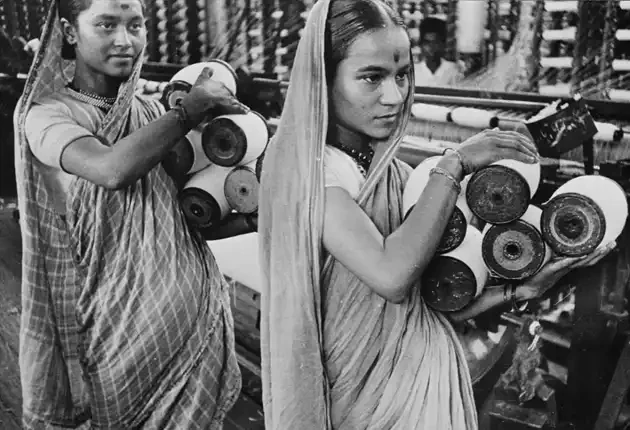
Image Courtesy: Young women workers in a booming Bombay textile mill, 1941-1943. Photo: Wikimedia Commons/ Farm Security Administration / Office of War Information, USA
The origins of textiles can be traced to man’s great transition from a nomadic, food-seeking hunting culture to a communal food-storing surplus civilization. Using culture, this evolution was confined around the four great river cradles of civilization- The Nile Valley, The Tigris-Euphrates Plain, The Yangtze Valley and The Indus Valley of North-Western India where it began in around 2500 BC. Primitive clothing styles were determined by the climate and nature of raw materials which naturally differed from region to region.
Very little has been known till now about the birth of the Indian textile industry, but it has been documented in various citations that this industry has its origins in the Indus Valley Civilisation as early as around 3000 BCE. People of that civilisation wore hand-spun cotton for garments using indigo colours in their fabric.
The Indian economy is predominantly agrarian and has been so since the time historians documented the Indian economy. In their records, it has also been mentioned that through time the second largest industry that has significantly contributed towards the growth of the nation is the textile industry. It has been the employer to millions of people across the length and breadth of the country.
The Indian Textile Industry: A 5000-Year Legacy
The textile industry of India, which is more than 5000 years old, has undergone significant developments starting from its modest beginnings as handlooms in villages to large-scale modern-day textile mills. From the Chola and Mughal eras to today, the Indian textile industry has come a long way. The story of textiles in India is one of the oldest in the world. The earliest surviving Indian cotton threads date to around 4000 BC and dyed fabrics from the region are documented as far back as 2500 BC. India’s textiles were so central to its identity abroad that in ancient Greece and Babylon the very name ‘India’ was shorthand for ‘cotton’.
The Indus Valley Connection
The Indus Valley Civilisation was the centre of textile production in India where a complete urban civilization centred around the two cities of Mohenjo Daro and Harappa, which thrived between 2500 and 2000 BC. During the excavation of these civilisations, along with the mini figurines and engraved seals, numerous spindle whorls of wool, anchors, cotton and some copper sewing needles were found. Impression of woven fabric and a large number of cotton seeds were also unearthed which date from 5000 BC by which time it appears that cotton cultivation and textile weaving were already in an advanced stage.
Historical Development Phases
The textile industry in India is an important segment of Indian industries and reflects the country’s diverse socio-economic and cultural heritage. The development of the textile industry in India can be classified broadly into three distinct stages – The pre-colonial period, the Colonial period and the post-independence period.
India’s Textile History at a Glance
- Indus Valley (c. 3000 BCE): cotton spun, woven and naturally dyed; cotton becomes so linked with India that its name travels with the cloth.
- Pre-colonial era: Indian calico, muslin and printed cottons are prized across Europe and Asia; artisans refine distinct regional styles.
- Colonial period (18th-19th c.): machine-made British imports and unequal import duties undercut Indian mills, and the indigenous industry declines.
- Independence movement: the boycott of British cloth and Gandhi’s promotion of hand-spun khadi make cloth a symbol of Swaraj (self-rule).
- After 1947: the All India Handloom Board (1952), the National Institute of Design (1961) and state initiatives rebuilt the sector.
- Today: the world’s second-largest producer (after China) and among its leading exporters (around the sixth largest), with the market near US$190 billion in 2025-26 and targets of about US$350 billion in size and US$100 billion in exports by 2030.
The Textile industry of India was well-known to the world much before the colonial period. Silk from China and Cotton from India were important import goods in the western countries. The access to markets was greatly amplified by the discovery of a sea route via the Cape of Good Hope in the 15th Century by the great traveller Vasco De Gama. With the entry of the East India Company, the production and trade of Indian textiles and fabrics in the medieval period were further intensified. Artisans developed their own styles of treating and decorating the textiles with locally available raw materials in each area. For instance, Tavernier wrote that Barouch (Bharuch), with large meadows full of lemon trees, was particularly known for the bleaching of textiles that required lime juice.
Pre-Colonial Period
In the pre-colonial period, a large variety of Indian Calico and other types of cotton production made inroads into the British Empire and the sheer variety of production styles and the skills of the Indian artisans accumulated through generations made the products manufactured in India far superior in quality and range than the textiles produced in Europe.
Colonial Period Impact
However, the situation began to change after the colonial period. As more affordable clothes made of machine-spun yarn flooded not only European but also Indian markets, the traditional hand-spun yarn and textiles faced stiff competition, which became even more pronounced with the use of chemical dyes in the West. After the Industrial Revolution began in England, it removed all import duties on British goods in the Indian market, while the English East India Company imposed heavy import duties on Indian clothes in the British markets. The Indian textile mills were not able to withstand the competition from machine-made goods produced in Britain, and gradually this led to the decline of the Indian textile industry during the colonial period.
Post-Independence Growth
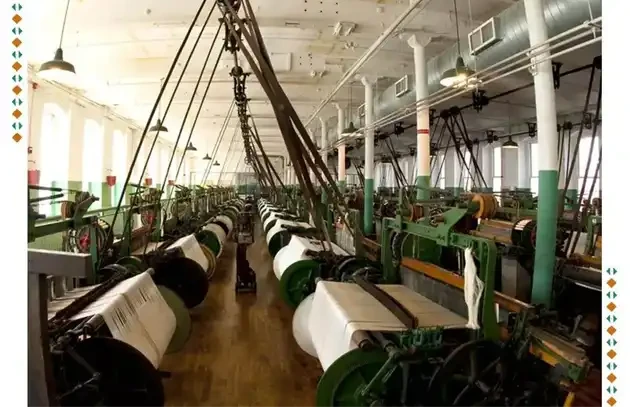
Image Courtesy: Post Independence Industrialised Era
With the singular agenda of maximizing profits, the textile industry in India like all other industries under the colonial regime suffered major losses. It is therefore very pertinent to analyse the situation with the independence movement of India and the boycott of British mill-made clothes and the promotion of khadi became the identity of Swaraj or the self-rule movement under the father of the nation Mahatma Gandhi.
Growth of the Indian Textile Industry post-Independence
The British Rule in India saw the imposition of various levies and taxes with import and export barriers to the already fledgling textile industry in India. Britain had already started exporting mill-made fabrics and yarns to India in the 1780s. The flooding of low-cost fabrics and textiles in India from Britain severely hampered and damaged the development of the indigenous textile industry. This situation created the cloth crisis in India during British rule.
On August 15, 1947, India attained freedom from British rule. Freedom also brought in a lot of challenges of industrialisation and modernisation. Alongside a drive to increase factory production to clothe India’s vast population, the government set up the All-India Handloom Board in 1952 to nurture hand-weaving and other textile crafts. In 1961, the National Institute of Design was established, and designers began to play a key role in the modernising process.
The Government of India rapidly took charge of the situation and implemented a slew of measures and initiatives to revive the textile industry. The Indian textiles industry is now a well-established one. The country is the second biggest textiles manufacturer worldwide, right after China. The Indian textile industry is an integral part of the overall manufacturing sector of the country and is a major contributor to the country’s economy. India’s textile industry is also the country’s largest employer after agriculture, providing direct work to more than 5.3 crore (53 million) people. It not only generates jobs in its own industry but also opens up scope for other ancillary sectors.
Current Scenario
Industry Structure and Strengths
The textiles and apparel industry in India has strengths across the entire value chain from fibre, yarn, and fabric to apparel. The Indian textile and apparel industry is highly diversified with a wide range of segments ranging from products of traditional handloom, handicrafts, wool, and silk products to the organized textile industry in India. The organized textile industry in India is characterized by the use of capital-intensive technology for the mass production of textile products and includes spinning, weaving, processing, and apparel manufacturing.
Market Position and Challenges
Textile Industry in India continues to be dominated by cotton, long the dominant fibre in India, although man-made fibres are a fast-growing share. India is now recognized as the largest producer of cotton and jute garments in the world. There is tough competition from China, Bangladesh, Pakistan, and Vietnam for exporting textile products to the global market. However, the Indian textile industry still manages for a comeback even after the decline of the business in 2020 – 21. Since the textile industry not only comprises large textile mills and high-end garment boutiques, self-employed artisans from rural areas are also promoted through government schemes, like MGNREGA. Many rural cooperatives and NGOs are also providing support to people working on a small scale for the textile industry.
Future Prospects
Growth Projections
The Indian textile industry is aiming to export products worth US$100 billion by 2030 (from about US$35.5 billion in FY2025-26). The promotion of this industry through several government schemes has been the greatest in the last three decades. The apparel industry is progressing fast with the manufacturing of more varieties of products. This textile business is also spreading in more countries across the world, leading to more earning of foreign money.
Emerging Opportunities
Owing to the pandemic, the demand for technical textiles in the form of PPE suits and equipment is on the rise. The government is supporting the sector through funding and machinery sponsoring. Top players in the sector are achieving sustainability in their products by manufacturing textiles that use natural recyclable materials. The technical textiles market for automotive textiles is projected to increase to US$ 3.7 billion by 2027, from US$ 2.4 billion in 2020. Similarly, the industrial textiles market is likely to increase at an 8% CAGR from US$ 2 billion in 2020 to US$ 3.3 billion in 2027. The overall Indian textiles market is expected to be worth more than US$ 350 billion by 2030.
Key Market Segments
With a rise in disposable income, the need for goods in the Indian textile sector has expanded, resulting in enormous demand in both the local and foreign markets. Consequently, India’s textile industry has a bright future due to the rapid expansion of the retail sector, government assistance, and investments.
Frequently Asked Questions
Q: How old is India’s textile industry?
A: More than 5,000 years. Its roots are in the Indus Valley Civilisation, where cotton was spun, woven and dyed by around 3000 BCE.
Q: How did colonial rule affect Indian textiles?
A: Cheap machine-made British cloth and unequal import duties undercut India’s handloom textiles, so the indigenous industry declined through the 18th and 19th centuries.
Q: How big is India’s textile industry today?
A: India is the world’s second-largest textile producer (after China) and among the leading exporters, around the sixth largest globally. The industry is targeting a market of about US$350 billion and exports of US$100 billion by 2030 (exports were about US$35.5 billion in FY2025-26).
Q: What role did khadi play in Indian textile history?
A: The boycott of British mill cloth and Mahatma Gandhi’s promotion of hand-spun khadi made cloth a symbol of Swaraj, or self-rule.
Interested in textiles and fashion as a career? Explore B.Des Fashion Design at UDIT.
About the Author:
Anushka Das is a textile-design expert and a Textile Design graduate of NIFT, New Delhi, with over 15 years in the textile and fashion industry. She has worked as Head Designer alongside Ritu Kumar and Neeru Kumar, leading collections for domestic and international clients, and in 2010 founded her own label, Anushka-Annasuya, which fuses Indian craft with contemporary design. Her work spans collaborations with Fabindia, Jaypore and Ajio across apparel and home; the Anzen and Fiori fabric-mask ranges she co-designed during the pandemic to support handloom weavers; and projects with the Ministry of Textiles and craft-focused NGOs. A committed advocate of sustainability, she works to a zero-waste philosophy and serves as a jury member and consultant, integrating traditional crafts into modern life.
More things to read